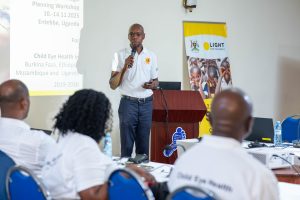
Child eye-health advocates want to improve and domesticate the education of eye-care professionals to curb the shortage of ophthalmologists in the country. Speaking at the close of a five-day strategic planning workshop in Entebbe, Sylvester Kasozi, the country representative of Light for the World Uganda, noted that Uganda currently has about 60 ophthalmologists a number that does not match the country’s eye-care burden.
Kasozi argued that there is a need to domesticate the training of ophthalmologists rather than sending a few trainees outside the country, and requires large sums of money. He added that there is a need to increase the outreach of eye-care services, including the provision of spectacles and surgical care, which remain unaffordable for most Ugandans.
Kasozi further urged the Ministry of Health to include more eye-care supplies on the essential medicines list. He noted that currently only a few items are provided for free, while hospitals must procure the rest increasing the burden of care on direct service users.
During the workshop, Light for the World asked the Ministry of Education to integrate eye health into the training of health-care workers. Kasozi said that while integration has been done for teachers, there is a dire need to extend it to health-care workers to increase their interest in eye health and improve early identification of children with eye problems at birth.
There are up to 3 million people grappling with eye-health problems, and between 80,000 and 100,000 people are totally blind. Kasozi noted that Light for the World aims to address eye-care problems at their onset to ensure that as few people as possible go blind.
Bugoosi Sarah Kibooli, the Commissioner for Special Needs and Inclusive Education at the Ministry of Education, noted the need to properly manage collected data to guide the next steps in addressing child eye health and to convince key stakeholders to understand and support child eye-care initiatives.
She noted that Uganda has several existing policies and called for child eye-care to be added to these policies to ensure that every child entering school is screened for early detection and timely intervention. Bugoosi also emphasized that teachers should be involved in capacity building to detect child eye-health problems in schools, since they spend more time with children than parents do.
Light for the World is focusing on child eye health to address eye-care problems early in life. Kasozi said that when eye-health problems are not detected and addressed early, it becomes difficult to treat or reverse them in adulthood.
The workshop brought together eye child eye care advocates and professionals from different countries such Ethiopia, Burkina Faso, Mozambique and Uganda who called on their governments to earmark more funding for eye care health. It was noted that stakeholder do not know how much budget the ministries of health in most of the countries is allocated for eye health which is critical for planning.