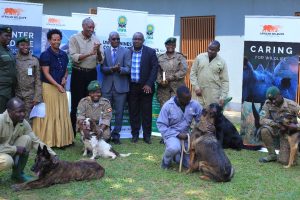
A team of highly trained dogs has become one of Uganda’s strongest weapons against wildlife traffickers. Now, the Uganda Wildlife Authority (UWA) has assumed full responsibility for managing this canine unit, in a shift that conservationists say will secure the program’s long-term future.
The takeover ends nearly a decade of joint management with the African Wildlife Foundation (AWF), which helped establish the initiative in 2016. Over the years, the dogs have sniffed out ivory, pangolin scales, and other illegal products, protecting Uganda’s wildlife while discouraging smugglers from using the country as a transit route.
In the early 2010s, Uganda was frequently flagged as a key channel for wildlife contraband, with seizures linked to the country discovered across Asia and the Middle East. The creation of the canine program marked a turning point, introducing specially trained detection dogs stationed at Entebbe International Airport and Karuma checkpoint.
“The real achievement is not how many arrests are made but the reduction in attempts,” said AWF Chief Executive Officer Kaddu Sebunya during the official handover. “When dogs go out and find nothing, it shows traffickers are already deterred.”
UWA has now made the unit a permanent part of its law enforcement structure, providing jobs for handlers, investing in modern kennels, and allocating resources for the animals’ care. According to Imelda Imetur, the warden leading the unit, the dogs’ efficiency has been transformational.
“They contribute 80 percent of detection capacity, while our handlers add intelligence and follow-up inspections,” she noted. “We used to register several arrests daily. Now, weeks can pass without a single incident, proving traffickers are avoiding Uganda.”
In addition to airport and checkpoint duties, tracking dogs are deployed in national parks to follow poachers’ trails, helping rangers protect endangered species.
The canine program reflects a broader conservation agenda advanced through UWA and AWF’s collaboration. These efforts include setting up community conservancies to ease human–wildlife conflict, building ranger outposts, and strengthening conservation education through the Classroom Africa initiative.
“This is African-led conservation in practice,” Sebunya remarked. “When local institutions build their own capacity, the survival of wildlife becomes more secure.”
Uganda’s canine model has now been replicated in countries such as Ethiopia, Kenya, and Mozambique. To bolster operations further, AWF donated three additional detection dogs during the handover.
For UWA’s Director of Field Operations, Charles Tumwesigye, the transition underscores sustainability. “A program without a long-term plan cannot last. By taking full control, we are showing Uganda has the manpower and commitment to drive this initiative forward,” he said.
Despite the progress, conservationists warn that trafficking will not end without reducing global demand for ivory, pangolin scales, and other products. Strong enforcement, they note, must be coupled with international cooperation to dismantle criminal networks. Still, the message from UWA is clear: Uganda is committed to leading the fight. “Our wildlife is our heritage,” Tumwesigye emphasized. “With initiatives like the canine unit, we are proving it can be protected.”