In a high-intensity emergency simulation staged at Entebbe International Airport, the Uganda Civil Aviation Authority (UCAA) put its crisis response systems and inter-agency coordination to the test. The full-scale exercise, conducted on Thursday afternoon, mimicked a catastrophic air crash, allowing stakeholders to assess readiness in the event of a real aviation disaster.
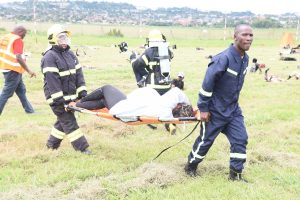
The operation, which kicked off at 1:09 PM, mobilized more than 600 personnel from over 50 agencies, including emergency medical teams, firefighting units, law enforcement, and airport staff. Thick clouds of smoke rose from designated zones, creating a realistic crash scenario involving multiple “casualties” and a chaotic rescue environment.
According to UCAA Director General Fred K. Bamwesigye, while these simulations are costly, they are vital in ensuring that Uganda adheres to global aviation safety protocols established by the International Civil Aviation Organization (ICAO). “We can’t afford to be unprepared,” he said. “In this drill, we simulated the loss of 26 lives and 33 injuries. It’s all hypothetical, but the readiness it demands is very real.”
Rescue crews managed to evacuate and “treat” 41 simulated survivors, some of whom were transported to mock medical centers as far away as Kampala. The drill tested not only first-response effectiveness but also communication flows, logistical coordination, and the capacity to operate under pressure.
Held periodically as part of ICAO requirements, these exercises help aviation authorities identify and fix weaknesses before a real incident occurs. “What we uncover here, is communication gaps, timing lags, coordination breakdowns is what ultimately saves lives later,” Bamwesigye added during a press briefing.
Previous drills at Entebbe have tackled bomb threats and aircraft landing malfunctions. According to Bamwesigye, these scenarios aren’t plucked from fiction; they mirror real emergencies faced by airports around the world. “The goal is to build muscle memory, not just for the airport teams but for all the stakeholders involved. Panic has no place in aviation.”
The drill also comes at a time when Entebbe International Airport is managing unprecedented growth in traffic. In April 2025 alone, the airport processed 185,466 international passengers, an average of 6,182 per day marking a notable increase from the daily average of 5,490 in April 2024.
Cargo volumes are also climbing. Last month, the airport handled over 6,098 metric tons of cargo, up from 5,721 tons in the same period last year. This growth has placed mounting pressure on the airport’s recently upgraded cargo terminals, which may soon require further expansion. “We are seeing sustained, rapid growth,” Bamwesigye said. “And the infrastructure we built yesterday may not meet the demands of tomorrow. We are already planning for more development.”
As Uganda’s only international gateway, Entebbe Airport plays a crucial role in both national and regional air transport. Current expansion efforts include runway renovations, upgraded terminals, and enhanced cargo handling systems all geared toward improving capacity and operational efficiency.
The urgency of such upgrades has only grown with Uganda Airlines’ recent launch of direct flights to the United Kingdom, a development expected to significantly boost inbound and outbound traffic. “New international routes are exciting milestones, but they also demand heightened vigilance, security, and preparedness,” Bamwesigye noted.
Closing his remarks, Bamwesigye appealed to Ugandans to rally behind national aviation development. “These are your facilities. Their safety, growth, and efficiency rely on the support of every stakeholder, government, private sector, and the public.”
He also stressed the importance of accurate public communication regarding the drill. “Let’s not incite panic. No real harm occurred. This was a simulation, an exercise designed to sharpen our response, not frighten the public.” As Entebbe Airport evolves to meet the demands of a growing aviation sector, the UCAA’s message is clear: expansion must go hand-in-hand with preparedness. In aviation, there are no shortcuts, and no room for error.