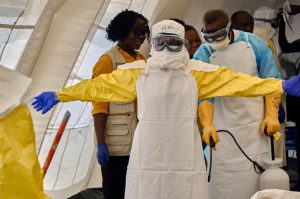
By Eric Kyama: As dawn broke over the bustling border town of Mpondwe in western Uganda, trucks laden with merchandise rolled slowly towards the Democratic Republic of Congo (DRC). Traders, students and families continued their daily crossings, but this time every traveller paused before reaching immigration. Temperatures were taken. Hands were sanitized. Health declaration forms were completed.
The border remained open.
It was a deliberate decision that reflected one of Uganda’s biggest diplomatic tests in recent years: how to protect its citizens from a deadly Ebola outbreak while preserving relations with one of its most important neighbours. When the Bundibugyo strain of Ebola erupted in eastern DRC in May 2026, few doubted the virus would eventually cross into Uganda.
The two countries share more than 800 kilometres of porous border, crossed daily by thousands of traders, refugees and families. What followed was not only a public health emergency but also a diplomatic balancing act.
Walking a fine line
For Uganda, shutting the border was never a realistic option. The DRC is among Uganda’s largest trading partners, with informal cross-border trade worth hundreds of millions of dollars annually. Thousands of Congolese seek medical treatment in Ugandan hospitals, while Ugandan businesses depend heavily on eastern Congo for markets.
Closing the border would have disrupted livelihoods, strained diplomatic relations and potentially encouraged illegal crossings that are harder to monitor. Instead, Uganda adopted what health experts describe as a “smart border” approach.
Health screening points were established at major crossings, surveillance was intensified and health workers deployed to monitor travellers without halting legitimate movement. Officials repeatedly emphasized that the response targeted the virus not the people carrying passports from Congo.
The approach aligned with guidance from the World Health Organization (WHO), which advised against blanket travel and trade restrictions because such measures often push movement underground and complicate disease surveillance.
A difficult diplomatic message
The first confirmed Ebola patients in Uganda were not the result of widespread community transmission. They were individuals infected in the DRC who crossed into Uganda seeking treatment.
This presented a diplomatic challenge.
Uganda needed to reassure its own population without appearing to blame its neighbour for the crisis. Government officials consistently described the cases as “imported” while stressing continued cooperation with Congolese authorities. Public messaging focused on solidarity rather than assigning responsibility.
Behind the scenes, health officials from both countries exchanged surveillance data, coordinated contact tracing and strengthened communication at border points. Regional cooperation became the cornerstone of Uganda’s response.
WHO Director-General Dr. Tedros Adhanom Ghebreyesus later praised Uganda’s surveillance systems while calling for even stronger regional collaboration, arguing that viruses respect neither borders nor political boundaries. Tedros noted that Uganda has mounted a strong response and its efficient surveillance, testing and case management systems have helped identify and manage cases quickly.
Fighting Fear Beyond Uganda’s Borders
Even as Uganda demonstrated one of Africa’s strongest Ebola response systems, another battle emerged—the international perception that the entire country had become unsafe. Several countries imposed travel restrictions, affecting tourism, trade and business confidence despite Uganda containing the outbreak relatively quickly.
Government officials embarked on a diplomatic campaign to reassure international partners that Uganda’s public health systems remained functional and that most infections had originated across the border before being detected through surveillance.
Following the discharge of the last Ebola patient, The Ugandan Government called for these restrictions to be lifted, arguing that they were disproportionate and economically damaging. “As we make progress in managing this disease, we are engaging and asking those countries to lift travel restrictions so that the economy does not get injured,” Uganda’s health minister, Dr Chris Baryomunsi, said during a press briefing.
Experience becomes Uganda’s greatest asset
Uganda’s calm response did not emerge overnight. The country has battled multiple Ebola outbreaks over the past two decades, building laboratories, emergency operations centres, isolation facilities and trained rapid-response teams.
These investments paid dividends when Ebola resurfaced in 2026. Contacts were identified quickly. Laboratory testing was accelerated. Treatment centres were activated. Health workers were mobilized before community transmission gained momentum.
By mid-July, Uganda had recorded only 20 confirmed cases and two deaths, with most infections linked to importation from the DRC rather than sustained domestic spread. The country subsequently entered the WHO’s mandatory 42-day countdown before being declared Ebola-free, provided no new cases emerged.
Regional health security
Uganda’s response also demonstrated a shift in thinking about epidemic control. Rather than treating Ebola solely as a national emergency, authorities increasingly viewed it as a regional security challenge requiring collective action.
Ugandan health teams worked alongside international partners to support surveillance efforts in neighbouring DRC, recognizing that controlling the outbreak at its source was ultimately the best protection for Uganda itself. International agencies similarly redirected funding towards strengthening cross-border preparedness, laboratory capacity and community engagement across the region.
Lessons beyond Ebola
Uganda’s handling of the outbreak illustrates that diplomacy and public health are inseparable in an interconnected world. Disease control is no longer achieved solely through hospitals and laboratories. It also depends on cooperation between governments, transparent information sharing and carefully crafted public communication that avoids stigmatizing neighbours while protecting national interests.
The Ebola outbreak tested Uganda’s health system, but it equally tested its diplomatic maturity. By keeping borders open under strict surveillance, maintaining close engagement with the DRC, collaborating with international partners and resisting politically popular but scientifically questionable travel bans, Uganda sought to demonstrate that effective outbreak management requires cooperation rather than isolation.
As eastern Africa remains vulnerable to emerging infectious diseases, the lessons from the Ebola response extend beyond one outbreak. They suggest that in the face of cross-border epidemics, diplomacy can become as vital as medicine itself.