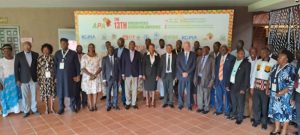
The 2025 Africa Potato Association (APA) Conference opened this week in Kampala with compelling calls for investment in climate-smart and nutrition-sensitive value chains for potato and sweet potato, as African nations face mounting pressure to boost food security, household incomes, and agricultural resilience amid intensifying climate impacts.
Hosted by the Government of Uganda in partnership with the National Agricultural Research Organization (NARO) and the International Potato Center (CIP), the five-day conference has convened over 300 scientists, policymakers, agribusiness actors, and development partners from 13 African countries and beyond. Themed “Fostering Climate-Smart Cropping Systems for Sustainable Potato Value Chains,” the conference focuses on how innovations in research and policy can drive more resilient, inclusive, and sustainable agri-food systems across the continent.
Frank Tumwebaze, the Minister for Agriculture, Animal Industry and Fisheries, opened the conference by highlighting the strategic importance of sweet potato and potato in the national and regional economy. “Sweet potato is now Uganda’s third most important crop, after cassava and bananas,” Tumwebaze noted. “It plays a vital role in food security, nutrition, and climate adaptation.”
While Uganda produces around 1.8 million metric tons of sweet potato and over 162,000 metric tons of potato annually, Tumwebaze acknowledged the production and market integration gaps, especially as the country still imports over 30,000 metric tons of potatoes even as it exports more than 55,000 metric tons regionally. “We have a clear opportunity to strengthen local production, improve quality, and build value-added industries that benefit our farmers and youth,” he said.
Marcus Prior, Country Director of the World Food Program (WFP) Uganda, underscored the nutritional and resilience-building potential of the orange-fleshed sweet potato (OFSP), particularly in fragile regions such as Karamoja. “The OFSP is not just a crop,” he said. “It is a tool for nutrition-sensitive agriculture, climate adaptation, and household resilience.”
Prior shared insights from WFP’s partnership with NARO and Andre Foods International (AFI), a Ugandan NGO, to promote OFSP production and consumption across nine districts in Karamoja one of Uganda’s most food-insecure regions. “Vitamin A deficiency remains a silent but deadly crisis here,” he warned. “Just 125 grams of OFSP can meet a child’s daily vitamin A requirement.”
Since 2022, the tripartite initiative has established five seed multiplication centers and trained nearly 8,500 farmers many of them women in OFSP production, post-harvest handling, and utilization. Over 2,100 acres have been planted, and 80 school gardens now integrate OFSP into school feeding programs. “Evidence from our joint impact study shows that 85% of households in target areas are now growing OFSP and have improved dietary diversity,” Prior said. “Those who grew OFSP were also better able to bridge hunger gaps during lean months.”
He emphasized that the success in Karamoja offers three key lessons: “First, food systems transformation starts locally; second, nutrition interventions must be integrated; and third, partnership is the multiplier. We call on policymakers, researchers, and donors to invest in decentralized seed systems and align OFSP with school feeding and climate-smart agriculture programs.”
Yona Baguma, Executive Director of NARO, reiterated the need for sustained investment in agricultural research to support Uganda’s crop development efforts. “Innovation must be continuous and well-funded,” he said. “We are building not just better crops, but also stronger institutions and capacities to support farmers.”
Representing the Food and Agriculture Organization of the United Nations (FAO), interim country representative Yergalem Taages Beraki applauded Uganda’s commitment to root and tuber crop development. “Potatoes and sweet potatoes are pillars of food security, income generation, and climate adaptation,” she said. “FAO is proud to partner in building inclusive value chains that ensure no one is left behind.”
Beraki highlighted FAO’s support to strengthening seed systems, training farmers, and promoting agroecological solutions. She said FAO would present new research on potato development in Eastern Africa during the conference. “This is the power of regional collaboration, knowledge exchange, and integrated programming in agricultural transformation,” she said.
Throughout the week, the APA conference is expected to yield policy and research recommendations, field demonstrations, and technology showcases that will feed into national and continental agricultural development strategies. “This is more than a technical dialogue,” said Tumwebaze. “It is a call to reimagine how Africa can leverage its staple crops to feed its people, empower its farmers, and protect its environment.”
Echoing that sentiment, Prior concluded with a plea for long-term, scalable solutions. “To truly move from nutrition to resilience, we must scale and sustain our interventions,” he said. “The orange-fleshed sweet potato, especially in fragile regions like Karamoja, offers us a chance to change lives. But only if we act boldly, invest smartly, and work together.”