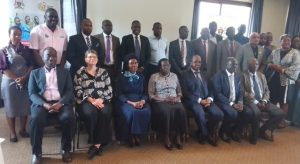
BY F MALE: Government has initiated a plan to establish a nationwide school feeding program aimed at addressing school feeding challenge in the country.
The new initiative is expected to roll out next year, led by a national multisectoral working group.
Eric Kakoole, Assistant Commissioner for Policy in the Education Ministry, outlined the initiative during a recent press briefing.
“The working group is set to provide guidance on implementing a sustainable national school feeding program. We aim to include a dedicated budget for this initiative in the upcoming 2025/2026 financial year,” Kakoole stated.
Dr. Jane Egau, Under Secretary in the Education Ministry, emphasized the importance of proper nutrition for children’s physical and cognitive development.
“School feeding is a critical issue that requires the attention of all stakeholders, including parents, teachers, and the government,” she asserted.
However, doubts remain regarding the government’s ability to fulfill its promises due to lack of an allocated budget to support the initiative.
Eric Kakoole Assistance Commissioner Policy and analysis at the ministry of Education assured the public that development partners like the World Food Programme (WFP) and UNICEF have pledged initial funding to support the working group.
Furthermore, Uganda’s recent membership in the School Meals Coalition, a part of the UN Food Systems Coordination Hub, is expected to attract additional resources for the program.
government also plans to conduct a nationwide survey, supported by the WFP, to gather comprehensive data on existing school feeding initiatives as plan of the effort.
“It’s essential to understand the current landscape, including programs funded by parents, schools, and development partners, before we establish a unified national feeding program,” Kakoole explained.
The 22 member committee of the National School Feeding Program has been challenged of being comprised of technocrats and lacks representation from those most affected by school feeding challenges.
The group primarily comprises development partners and officials from various ministries, with limited input from students, teachers, or local government representatives.
During a recent launch meeting in Kampala, attendees raised concerns about the lack of direct representation from those experiencing hunger in schools.
“How can we have a committee discussing school feeding without including learners or teachers? Their insights are vital for understanding the issues at hand,” a participant remarked.
Participants expressed frustration that many national committees tend to be populated by desk officers and international representatives, often resulting in recommendations that are disconnected from the realities faced by students and educators on the ground.
Millions of children in Uganda attend school on empty stomachs which hinders their ability of learning effectively and also grow.