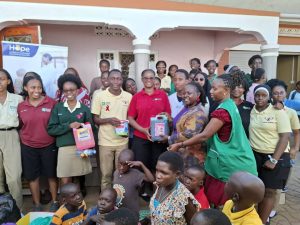
BY D Kasule: Palliative Care Association of Uganda (PCAU), together with students from Taiba International School, have extended compassionate support to children living with Cancer.
Through the school’s Palliative Care Club and Cancer Awareness Club, these young people, have supplied daily consumer products like soap, sugar, detergent, among others, above all words of encouragement, care and compassion to the young patients, narrations meant to uplift their spirits in the fight of this limiting to ailment. Whereas PCAU, provided a 100 sitter tent for a shade to the hostel.
This outreach to Mulago Hospital Pediatric Cancer ward, and New Hope Nursing Hostel in Kawempe, a shelter that accommodates children undergoing cancer treatment, reflects a shift in how young Ugandans view illness, compassion, and community responsibility. This moves palliative care in Uganda from heavily depending on non-governmental organizations, faith groups, and small volunteer networks.
“Palliative care is about the during and after of illness,” explains Mary Tibayeta, a student, president of the Palliative Care Club. “People think treatment is only medical, but healing also requires emotional and mental support. Our club helps us see through this journey clearly.”
Tibayeta’s understanding is shaped by months of closely working with her fellow students and the club’s patron, Safra Amumpire. Under her guidance, the club has grown to over 130 members one of the largest student-led compassionate-care groups in Ugandan schools today.
According to Amumpire, Taiba’s unique culture is part of the reason behind the club’s strong membership. The school promotes five core values known as the “Five Cs”: confidence, creativity, critical thinking, communication, and concern for community. The last C-concern for community-has created fertile ground for palliative-care work to flourish.
“The school supports us fully,” she says. “The administration provides transport, fuel, and encourages student involvement. It is part of who we are.”
She adds that the club collaborates closely with PCAU and often takes part in outreach programs. But the heart of their initiative is not the donation, it is the learning and empathy that students experience when they step into spaces where children and families are fighting for hope.
At Kawempe, the hostel accommodates 35 children and 35 caretakers, mostly referred by the Uganda Cancer Institute. Many come from far-off regions like Gulu, Moroto, Napak, and other northern areas because travelling to and from Mulago every week is impossible for families who barely afford transport.
The hostel Program Manager and co-founder, Sarah Komugisha, say the hostel started in 2016, after health workers noticed heartbreaking scenes: children sleeping on verandas at Mulago, exposed to rain and sunshine, because their families had nowhere to stay.
“Some were even begging on the streets,” she says. “We needed to give them dignity and a safe place during treatment.”
According to, space remains limited, and daily needs, food, bedding, toiletries, transport, depend entirely on donations from well-wishers, schools, and Rotary Clubs.
Although the hostel does not provide treatment, it plays a crucial role in ensuring children remain stable enough to continue care. “Each child is required to come with a caretaker” she noted. “Usually a parent, though there are cases of abandoned children whom the hostel cannot turn away.”
Palliative care for children is not just about medicine it involves keeping them fed, sheltered, emotionally supported, and able to attend their hospital appointments. For many families, especially from northern Uganda, this support is the reason children complete treatment.
This reality deeply shaped the reflections of students like Tibayeta and cancer-club president Ainomugisha Everest. “You can never understand someone’s pain until you see it first-hand,” he says. The club was born out of a desire to reach children who often remain invisible in community programs. Seeing the environment where children live during cancer treatment has strengthened the students’ commitment to long-term involvement.
For Tibayeta, the experience has changed how she sees leadership, compassion, and her own future.
“Once the palliative-care mindset enters your head, it cannot leave,” she says. “I want to carry this beyond school. You’re never too young to help.”
These voices reflect a growing awareness among Ugandan youth: that palliative care is not the job of doctors alone. It is a community responsibility one that requires empathy, understanding, and the courage to walk with others through difficult journeys.