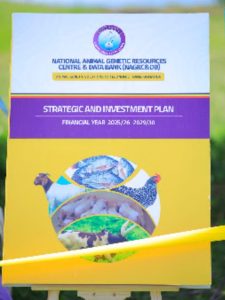
The Government has pledged to support the National Animal Genetic Resources Centre and Data Bank (NAGRC&DB) to expand the production and multiplication of improved livestock breeds for distribution to beneficiaries of the Parish Development Model (PDM).
The support is expected to enable NAGRC&DB to increase the supply of improved dairy heifers, poultry, piglets and other breeding stock as the Government intensifies efforts to transform smallholder farmers from subsistence producers into commercially oriented farmers.
The commitment comes as NAGRC&DB prepares to implement its priorities for the 2026/2027 financial year, with increased production of breeding stock, improved animal genetics and wider access to livestock technologies forming part of the agency’s key priorities.
The plans were discussed during a two-day strategic retreat of the NAGRC&DB Board of Directors and management held in Entebbe on August 6 and 7. The retreat focused on the implementation of the National Animal Breeding Strategy and Action Plan, which seeks to commercialise animal breeding, increase livestock productivity and conserve Uganda’s indigenous genetic resources across the dairy, beef, goat, pig, poultry and fish value chains.
NAGRC&DB Board Chairperson Ben Anyama said the agency would intensify mass breeding and multiplication of high-performing and climate-smart breeds to ensure that farmers have access to quality genetics.
“The National Animal Breeding Strategy is focusing on enhancing commercialization of breeding, boosting livestock productivity, and conserving indigenous genetic resources across dairy, beef, pigs, poultry, and fish value chains,” Anyama said.
He said government support would be critical in enabling NAGRC&DB to expand its breeding programmes and make improved genetics accessible to farmers across the country. “This is not just about increasing numbers; it is about ensuring that every farmer, regardless of scale, can access superior genetics,” Anyama added.
Government support to boost PDM livestock programme
The planned expansion is expected to strengthen the implementation of the PDM by increasing the availability of breeding stock for rural households. NAGRC&DB says it has aligned its operations with PDM to reach last-mile farmers, with particular emphasis on providing improved dairy animals, poultry and pigs that can generate income for households.
The agency is also strengthening community-based animal breeding programmes through which farmers are organised into breeding societies and trained in genetic selection, artificial insemination, disease control and improved animal husbandry.
The model has already recorded progress in regions including the Busoga sub-region and the cattle corridor.
With additional government support, NAGRC&DB is expected to increase the scale of multiplication and distribution while improving the capacity of farmers to manage the animals supplied to them.
Kasolwe positioned as breeding and multiplication hub.
At the Kasolwe Stock Farm, NAGRC&DB has invested in livestock breeding, animal feed production and forage development to support the multiplication of improved breeds. The farm, which covers more than a square mile, has extensive areas planted with animal forages, including grasses, hay, maize and protein-rich supplements.
Kasolwe has also become a centre for the multiplication of improved breeds, including the Kasolwe Brown goat, developed through NAGRC&DB’s genetic improvement programmes.
According to Dr Katali Benda, NAGRC&DB programme officer for small ruminants, the Kasolwe Brown goat is drought-tolerant, fast-growing and relatively resistant to diseases commonly affecting goats in Uganda. He said female goats can weigh up to 65 kilogrammes at maturity, while males can reach up to 75 kilogrammes. The goats can also produce multiple kids, with some capable of producing up to four kids a year, giving farmers an opportunity to expand their herds more rapidly.
NAGRC&DB already supplying improved breeds
NAGRC&DB has already been multiplying and distributing improved poultry, pigs and cattle to farmers.
In the Busoga sub-region alone, the agency says it has distributed more than 500,000 improved Kuroiler chicks, 10,000 crossbred bulls, 5,000 pigs and 165 Kasolwe Brown goats.
The improved dual-purpose Kuroiler birds can produce between 150 and 200 eggs annually, compared with about 40 eggs from many indigenous chickens. They can also attain market weights of between two and 3.5 kilogrammes within approximately five months.
The agency has also expanded artificial insemination services. More than 10,000 cattle in the Busoga sub-region have been inseminated over the past two years, according to NAGRC&DB.
The programme is intended to improve herd quality, increase milk production and accelerate genetic improvement among farmers. NAGRC&DB also produces and supplies improved semen and liquid nitrogen to farmers and breeding service providers across the country.
Investment in feeds to support breeding stock
Government’s support is also expected to complement investments already being made by NAGRC&DB in animal feed production. The agency says its heavy-duty feed production machinery at Kasolwe is producing compounded feeds for poultry, pigs and dairy cattle.
The availability of quality feeds is expected to complement the distribution of improved breeding stock by helping farmers maintain animal health and productivity. NAGRC&DB says community-based breeding programmes will also provide farmers with practical training in artificial insemination, disease control and genetic selection.
“Farmers can now access subsidized, superior genetics that produce more milk, meat, and eggs, directly boosting household incomes,” the agency said. The agency is also placing emphasis on indigenous and climate-smart breeds to help farmers withstand the effects of climate change while maintaining livestock productivity.
Women and youth to benefit
The programme will also target women, youth and persons with disabilities as part of the Government’s broader strategy of promoting inclusive agricultural development. NAGRC&DB says increased access to improved livestock, technical training and breeding services will create opportunities for more rural households to generate sustainable incomes.
The livestock sector is a major contributor to Uganda’s economy.
Data cited during the retreat indicates that livestock supports about 71 per cent of Ugandan households and contributes approximately 4.5 per cent to the national GDP. Within the agricultural sector, livestock contributes about 17 per cent of agricultural GDP, with dairy accounting for an estimated 40 to 50 per cent of livestock’s contribution.
Shs56.96 billion investment in breeding infrastructure
The Government’s pledge comes amid increased investment in livestock breeding infrastructure. In March 2026, Parliament endorsed a Shs56.96 billion investment in livestock breeding infrastructure, including the Bukedea and Serere breeding centres, under the Fourth National Development Plan (NDP IV).
The investment is expected to support mass multiplication of improved breeds, restocking programmes and community-based breeding initiatives. With the additional government support, NAGRC&DB is expected to expand its breeding capacity and increase the volume of livestock available for PDM beneficiaries.
The agency’s strategy is to combine improved genetics, animal feeds, farmer training, artificial insemination and community-based breeding to raise livestock productivity and incomes. The ultimate goal is to ensure that PDM beneficiaries have access to productive breeding stock capable of generating sustainable household incomes while contributing to Uganda’s food security, employment creation and commercialisation of agriculture.