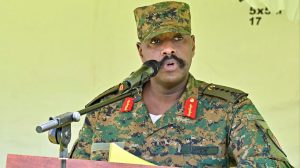
By Eric Kyama: When General Muhoozi Kainerugaba posted on X (formerly Twitter) in October 2022 that it would take him “two weeks” to capture Kenya’s capital, Nairobi, many dismissed it as another provocative social media outburst.
Kenyans were less amused.
The tweet quickly dominated headlines across East Africa, prompting diplomatic concern, public outrage and eventually an apology from President Yoweri Museveni, who described the remarks as “incorrect.” It was one of the clearest examples of how a single social media post from a senior military officer could ripple through diplomatic circles, forcing Uganda’s foreign policy establishment into damage-control mode.
Nearly four years later, the pattern has continued. As Uganda’s Chief of Defence Forces and the son of President Museveni, Gen. Muhoozi occupies an influential position in both the country’s military and political landscape. His frequent, often controversial posts on X have repeatedly tested Uganda’s diplomatic relationships with neighbours, development partners and the wider international community.
Diplomacy in 280 characters
Traditionally, diplomacy has been the preserve of ministries of foreign affairs, ambassadors and carefully negotiated communiqués.
Social media has changed that.
Today, a single post from a high-ranking official can shape international perceptions before diplomats have an opportunity to clarify government policy. For Uganda’s Ministry of Foreign Affairs, Gen. Muhoozi’s online presence has frequently meant responding to controversies it did not initiate.
The ministry has on several occasions emphasized that Uganda’s foreign policy is determined through established constitutional and diplomatic channels, not through personal social media accounts. The Minister of ICT and National Guidance, Dr. Chris Baryomunsi, explained that General Muhoozi’s comments on X were made on social media, casually, privately, and not the official position of The government of Uganda.
Neighbours become concerned
The Kenya incident may have been the most famous, but it was far from the last. In December 2024, Gen. Muhoozi posted messages suggesting military action against Sudan and warning armed groups and foreign fighters operating in eastern Democratic Republic of Congo (DRC). The remarks prompted formal diplomatic protests from both Sudan and the DRC.
Sudan’s Ministry of Foreign Affairs described the statements as “reckless and irresponsible” and demanded an official apology from Uganda, arguing that they violated international diplomatic norms and threatened regional stability.
Uganda’s government quickly moved to contain the fallout. State Minister for Foreign Affairs Henry Okello Oryem publicly described the comments as “regrettable,” adding that Kampala had already communicated with Sudan through diplomatic channels to express regret and reaffirm Uganda’s commitment to peaceful relations.
Officials also confirmed receiving protest notes from both Sudan and the DRC and indicated that formal diplomatic responses would follow.
Walking a diplomatic tightrope
The repeated controversies have exposed an unusual challenge for Uganda’s diplomats. Unlike disputes arising from official government policy, many of these incidents stem from remarks made on a personal social media account by someone who nevertheless holds one of the country’s highest military offices.
That dual role has complicated Uganda’s messaging abroad. Foreign governments often struggle to distinguish between personal expression and official state policy when the speaker is simultaneously the commander of the national armed forces.
Each controversial post has therefore required reassurance that Uganda’s established foreign policy remains unchanged. Government spokesperson Ofwono Opondo has publicly questioned whether such social media conduct is appropriate for someone occupying such a senior security office, noting that similar behaviour would be unusual among military chiefs elsewhere.
Beyond the region
The diplomatic consequences have not been limited to East Africa. Relations with Germany came under strain in 2025 after escalating exchanges involving Gen. Muhoozi and allegations by Muhoozi that Germany Ambassador Mathias Schauer was engaging in undiplomatic practices and funding or mobilizing groups opposed to the Ugandan government.
Germany rejected the allegations as baseless, while Uganda suspended aspects of military cooperation with Berlin, marking one of the most serious diplomatic disagreements between the two countries in recent years. The episode illustrated how online rhetoric, domestic politics and international diplomacy can quickly become intertwined.
Reputation matters
Diplomats often argue that international relations depend as much on trust as on treaties. Repeated controversies can affect how foreign governments interpret future statements and policies, even when official diplomatic channels later provide clarification.
Political analysts note that modern diplomacy increasingly includes what scholars call digital diplomacy—the management of a country’s reputation through online communication. In this environment, social media posts from senior officials can influence investor confidence, bilateral cooperation, tourism and international perceptions of political stability.
For Uganda, whose economy depends heavily on regional trade, international development partnerships and security cooperation, preserving diplomatic confidence remains strategically important.
A new challenge for foreign ministries
The Muhoozi episodes also reflect a broader global phenomenon. Governments worldwide are grappling with the reality that social media has compressed diplomatic timelines. Statements that once might have been confined to private conversations now reach millions of people instantly, leaving little room for careful consultation before reactions begin.
Foreign ministries increasingly find themselves responding not only to official policy announcements but also to viral posts made by influential public officials. For Uganda, this has meant balancing two sometimes competing priorities: respecting the prominence of one of its most senior military leaders while reassuring international partners that official foreign policy remains consistent, predictable and rooted in diplomatic engagement.
The lasting lesson
Whether viewed as personal opinion, political messaging or strategic communication, Gen. Muhoozi Kainerugaba’s tweets have demonstrated the growing influence of social media on international relations.
They have prompted diplomatic protests, required official explanations, and occasionally drawn apologies or clarifications from Uganda’s government. They have also sparked wider debates about the responsibilities of senior public officials in the digital age and the blurred line between personal expression and state representation.
In an era where diplomacy increasingly unfolds in real time on social media, Uganda’s experience offers a cautionary lesson: a message posted in seconds can require weeks—or even months—of diplomatic engagement to repair.