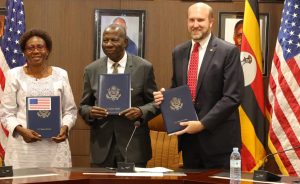
BY DENIS KASULE: The health sector has received a USD 2.3 billion boost through a Uganda, United States five-year health cooperation agreement. The deal, marks one of the largest bilateral health investments Uganda has received in recent years and is expected to strengthen health services, improve disease surveillance, and support key national priorities. Under the new Memorandum of Understanding (MOU), the United States will contribute USD 1.7 billion, while Uganda will invest USD 500 million over the same period. The partnership will run from 2026 to 2030.
Speaking at the signing ceremony today, Minister of Finance Matia Kasaija described the agreement as a “building block” in the long-standing cooperation between the two countries. He said the funds will support a wide range of health programs, including HIV/AIDS, tuberculosis, malaria, maternal and child health, and global health security. He noted that Uganda is expected to gradually increase its domestic financing as external support reduces.
“We take note of the requirement for Uganda to gradually increase its budget to USD 500 million as external support decreases,” he said. “This collaboration will not only result in disease-specific outcomes, but also strengthen our national systems, institutions, and workforce.”
Kasaijja, praised the joint work that led to the completion of the MOU, saying it reflects a shared commitment to building a stronger and more resilient health system. US Ambassador to Uganda William Popp described the agreement as a “historic milestone” in the health partnership between the two nations.
He explained that the new framework focuses on national leadership, accountability, and building sustainable systems rather than relying on parallel structures. “For more than six decades, the United States has been Uganda’s largest health and development partner,” Ambassador Popp said. “But the previous model created parallel systems and a culture of dependence, and that model is changing.”
He said the new arrangement aligns with the America First Global Health Strategy, which emphasizes making partner countries more self-reliant while protecting Americans from global health threats. According to Ambassador Popp, more than 1,100 community health extension workers have already been trained under US support, and the MOU will help Uganda transition to a unified, government-led workforce. Over the next five years, more than 14,000 community health workers will be trained and equipped.
The US funding will support major programs such as HIV/AIDS, tuberculosis, malaria, maternal and child health, polio eradication, laboratory networks, and emergency preparedness. Ambassador Popp emphasized that Uganda’s commitment of USD 500 million shows a strong move toward sustainable domestic financing and full national ownership of its health system.
Minister of Health Dr. Ruth Aceng said the agreement marks the beginning of a new era in the Uganda-US health partnership. “This is not just about signing a document. It is about sealing a transformative five-year partnership valued at USD 2.3 billion,” Dr. Aceng said. “It is a powerful testament to decades of friendship and a vote of confidence in our vision.”
She explained that the support consists of two streams: direct budget support that allows Uganda to recruit health workers and maintain infrastructure, and off-budget support that covers essential medicines, technical assistance, and other services. Aceng highlighted lessons from recent disease outbreaks, including Ebola, Marburg, and COVID-19, saying they proved that strong health systems protect both Uganda and the world.
She said the agreement includes a respectful framework for sharing data during public health emergencies while protecting Uganda’s sovereignty and complying with national laws and ethics. The partnership is expected to deliver practical benefits for Ugandans, including more doctors, nurses, midwives, and community health workers. It will also improve laboratories, strengthen disease surveillance, expand primary health care, and boost the country’s preparedness for future pandemics.
Aceng assured Ugandans that the government is fully committed to turning the investment into real improvements in health facilities and services. “Today marks the beginning of five years of intense and results-driven collaboration. Let us move from commitment to delivery,” she said.
The signing of the MOU reflects a shared goal: building a resilient, self-sustaining health system capable of protecting Ugandans while contributing to global health security. Over the next five years, the partnership is expected to change the way health services are delivered, placing Uganda in a stronger position to manage diseases, respond to emergencies, and improve the overall well-being of its people.