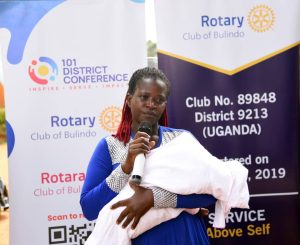
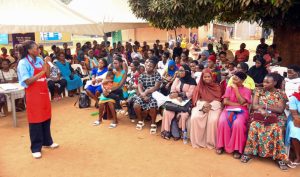
BY DENIS KASULE: More than 400 women most of them new and expectant mothers, have received a unique economic empowerment from the Rotary Club of Bulindo. Gathered at Kasangati Health Centre IV over the weekend, the drive was in partnership with Rotary Club of Kitukutwe, Rotaract Bulindo, Centenary Bank and Old Mutual.
Paul Persy Lubega, the president of the Rotary Club of Bulindo, said the drive aims to equip women at the lowest income levels with financial literacy and practical skills to help them start small businesses, save consistently, and build stable livelihoods for their families.
In Uganda, women form the backbone of the informal economy, yet many remain financially excluded. According to the Uganda Bureau of Statistics, more than 60% of women are employed in low-income, informal activities with minimal safety nets. The challenge is especially severe for young mothers, many of whom face abandonment or reduced household income once they become pregnant.
Lubega said the initiative specifically targeted women who had delivered at Kasangati Health Centre IV or were attending antenatal care. “These are mostly low-income mothers. Many are single or were abandoned during pregnancy,” he explained. “Economic empowerment is the surest way to help them care for their families and live decent lives.”
He added that Rotary places strong emphasis on lifting communities through practical skills such as saving, budgeting and business management. Lubega said several testimonies shared during the training demonstrated how small beginnings can lead to major breakthroughs.
“One of the women said she started her business with only 10,000 shillings, and today she runs a venture worth over 100 million,” he noted. “Stories like these show that even the smallest investment can grow if combined with discipline and consistent saving.”
While the names of the speakers were not disclosed, the room was full of similar accounts, women who once struggled to buy soap or food but now earn steady income from roadside stalls, tailoring, poultry or mobile money kiosks. Among the participants was Nakiranda Sarah, a 22-year-old first-time mother who survives on casual labor.
Before the training, she depended entirely on the child’s father, who recently stopped providing support. She said the session on saving “opened her eyes,” especially after learning how daily saving of even 1,000 shillings can build capital over time.
Another participant, Sitankya Mariam, an expectant mother of two, said she plans to start a chapati stall near her home in Kyaliwajjala. After learning about record-keeping and reinvesting profits, she believes she can grow her business quickly. “I didn’t know banks have accounts for small earners,” she said, referring to Centenary Bank’s low-cost saving products showcased during the training.
These examples mirror the realities of many Ugandan women, especially single mothers, who struggle to balance childcare, health needs and income generation. Economic empowerment programs like this one help bridge gaps that government health facilities often cannot fill.
Representatives from Centenary Bank and Old Mutual trained the women on: How to open and operate simple saving accounts, How to borrow responsibly, Insurance options for low-income earners and Flexible saving products designed for market women and small traders
With most attendees lacking prior financial literacy, trainers simplified the content using examples of market vendors, boda boda savings groups and neighbour-to-neighbour lending circles. Uganda’s economy depends heavily on women’s unpaid and informal labour. Despite this, many women lack business skills, start-up capital, or support networks. Civil society interventions, often led by Rotary clubs, churches and women groups, fill a critical gap in supporting vulnerable mothers.
The Kasangati program aligns with the broader push for community-based economic empowerment, lifting communities from subsistence to income-generating activities. For many mothers, however, success depends not only on access to funds but on knowledge, how to budget, save, and manage a microbusiness. That is where Rotary’s intervention becomes transformative.
Lubega concluded with a reminder that empowering mothers has a ripple effect across families. “When you empower a woman, you empower a whole community,” he said. “If these mothers become financially stable, their children will be healthier, better fed and better educated.”