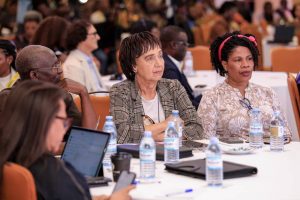
BY D KASULE: The 2025 Africa Industrialization Week has renewed calls for African governments to prioritize value addition, remove policy barriers, and build regional industries that can compete globally. The five-day event at Speke Resort Munyonyo has brought together policymakers, private sector leaders, development partners, and innovators from across the continent.
Opening the conference, Uganda’s Minister of State for Trade, Industry and Cooperatives, Hon. David Bahati, said Africa cannot achieve meaningful development if it continues exporting raw materials and importing finished goods made from the same resources. He noted that the continent’s industrial output remains low, contributing just 10.4 percent to Africa’s GDP and only 2 percent of global manufacturing.
Bahati stressed that industrialization is not simply an economic program but a political choice that shapes Africa’s sovereignty and global competitiveness. He said this year’s theme “Transforming Africa’s Economy Through Sustainable Industrialization, Regional Integration and Innovation,” underscores the need for African countries to work together to strengthen regional value chains.
He pointed to the African Continental Free Trade Area (AfCFTA) as the continent’s strongest opportunity for economic transformation. With a combined market of 1.5 billion people and a GDP of USD 3 trillion, AfCFTA gives African producers the chance to trade across borders without facing fragmented national markets. “AfCFTA is not just about removing tariffs; it is about creating a unified market where an entrepreneur in Kampala can see consumers in Accra as part of the same domestic market,” Bahati said.
Uganda’s own experience shows the gains of value addition. Manufacturing now contributes 15.6 percent to GDP, while manufactured goods account for about 24 percent of exports, up from none in 1986. Uganda has become a net exporter of products it once imported, including soap, sugar, steel, paper, cement and processed foods. Bahati said this progress proves the economic logic behind processing coffee, milk and minerals locally.
The Permanent Secretary of the Ministry, Ms. Geraldine Ssali, called for stronger policy reforms to support industrial expansion. She said sustainable industrialization requires reliable infrastructure, affordable financing, innovation systems, and regulations that enable rather than constrain production. Ssali encouraged delegates to use the week to form partnerships and push for practical solutions.
She highlighted several parallel events, such as the African Women in Processing Forum, the African Youth Start-ups Forum, the Innovation and Enterprise Convention, and the Africa Manufacturing Investment Forum. These platforms focus on investment, technology transfer, standards, skills development and market access areas where many African enterprises still face barriers.
The Secretary General of the Pan-African Women’s Organization (PAWO), H.E. Dr. Grace Kabayo, said Africa’s industrial future depends on bringing women and young people into the center of value addition. She outlined PAWO’s efforts to help women transition from micro-scale production into regional value chains through financing support, standards compliance, market linkages, and policy advocacy.
Kabayo reminded delegates that women already dominate many of Africa’s productive sectors, especially agriculture and informal manufacturing, and must therefore be fully included in industrial strategies. She urged governments and financial institutions to create dedicated financing windows for women and youth innovators.
Throughout the opening, speakers agreed that Africa must shift from exporting raw materials to building industries that serve the continent’s needs. They stressed that regional industrialization will succeed only through harmonized laws, cross-border infrastructure, and full implementation of the AfCFTA.
As discussions continue, delegates are expected to focus on investment priorities, technology adoption, industrial financing and building regional manufacturing clusters. Uganda hopes the outcomes will provide clear steps for African governments to boost industrial output and expand opportunities for the continent’s growing youth population