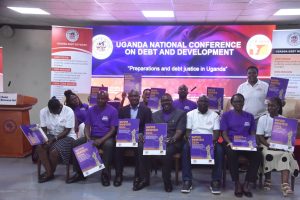
Uganda has become the latest country to embrace the feminist economic framework “Maputo Manifesto” which seeks to redefine the continent’s development trajectory. This has been rolled out by the Uganda Debt Network (UDN), in partnership with the African Forum and Network on Debt and Development (AFRODAD), during the fifth national debt conference.
The Manifesto is a continental rallying cry, emerging from years of consultation with feminist economists, civil society leaders, and grassroots activists across Africa. “Women who form the backbone of Africa’s informal economy must be repositioned from the margins to the core of economic policymaking,” is its central message.
Penina Nayiga, a research associate at UDN, say “In most African countries, debt is not a neutral statistic it’s a gendered crisis.” she said “When health and education budgets are slashed to service external loans, it’s women and girls who suffer first and longest.”
According to UDN CEO Patrick Tumwebaze, Uganda, like many of its neighbors, finds itself at a fiscal crossroads. Public debt has ballooned to UGX 106 trillion (approximately USD 29 billion), in just six months, the figure jumped by UGX 12 trillion, sparking warnings from economists that the country may soon slip into high-risk debt distress.
Fred Muhumuza, a leading economist, noted that Uganda’s debt-to-GDP ratio reached 51% by the end of 2024 a level he deemed “dangerously unsustainable.” Beyond statistics, the consequences are already visible: budget cuts in essential services, especially those disproportionately relied upon by women, such as healthcare and education. “Africa-wide, the debt crisis is no less severe. From 2010 to 2021, interest payments by African governments surged by 132%. Today, nearly half of the continent’s countries spend more on debt servicing than on social sectors,” he said.
The Maputo Manifesto points to this imbalance as evidence of systemic failure one that requires not just economic adjustment, but ideological transformation. At its core, the Maputo Manifesto is a challenge to status quo economic orthodoxy. It proposes a feminist economic model grounded in care, equity, and sustainability one that values social well-being over profit maximization.
The document outlines five philosophical pillars: Afro-feminist identity, decolonization of systems, historical memory, resistance against neoliberalism, and the reclamation of indigenous values. It calls for concrete action: reforming tax regimes, abolishing discriminatory laws, investing in caregiving sectors, and restructuring or cancelling illegitimate debt.
“What we need is not just debt relief, but debt justice,” said Fidélité Nshimiyimana of AFRODAD. “Women carry the burden of fiscal austerity, yet they are excluded from the table where those decisions are made. That has to change.” While the launch of the Manifesto marks a philosophical shift, the road to implementation is steep. Uganda’s informal sector where 90% of women are employed remains largely invisible in national policy calculations. The conference highlighted the urgent need to integrate gender-responsive budgeting and to institutionalize women’s voices in economic planning.
The event also laid bare Uganda’s internal disparities. Jonathan Ebwalu, MP for Soroti West, warned that economic marginalization isn’t just gendered, it’s regional. “Nearly half of all top-tier jobs are concentrated in one region,” he said. “Meanwhile, places like Teso, once thriving, are being left behind.”
His comments underline a larger truth: any strategy to rebuild Africa’s economies must confront intersecting layers of inequality gender, region, class, and historical injustice.
The Maputo Manifesto was first conceived at the 4th African Conference on Debt and Development (AfCoDD IV) in Mozambique and formally launched at AfCoDD V in Kampala. The document now seeks endorsements from across the continent, aiming to build momentum for a feminist-led transformation of Africa’s development agenda.
Within three months, civil society groups, governments, and international partners are being called upon to sign and commit to its principles. Organizers believe the success of the Manifesto depends not just on policy changes, but on a collective reimagining of Africa’s role in the global economic order from rule-taker to rule-maker. “We cannot continue to service a debt that costs us our future,” said Tumwebaze. “If we are to build resilient economies, we must begin by listening to those who hold them up, the women.”