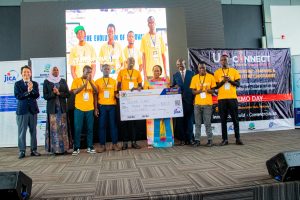
BY D KASULE: Four teams of Ugandan student innovators have won a combined USD 6,500 (about Shs26.5 million) for developing homegrown technological solutions to local challenges.
The awards were announced at the conclusion of the fourth cohort of the UJ-CONNECT Entrepreneurship Mentorship Programme, a joint initiative supported by the governments of Uganda and Japan.
Solar Care, an automated solar panel cleaning system, emerged the overall winner, receiving USD 3,000. HydroGuard, a firefighting robot designed to support emergency responders, was the first runner-up, taking home USD 2,000.
Zapher Farm, which developed an offline, artificial intelligence-powered application for detecting crop diseases, received USD 1,000, while EcoSwap Energies, a developer of solar-powered battery-swapping stations for electric motorcycles, won USD 500.
The four teams emerged from a pool of 56 Uganda Institute of Information and Communications Technology (UICT) students who underwent three months of training and mentorship between August and October 2026. The programme focused on business development, market validation, prototype refinement and investment readiness.
The Demo Day, held under the theme “From Ideas to Enterprises – Empowering Uganda’s Next Generation of Technology Entrepreneurs,” showcased locally developed technologies aimed at addressing community challenges, creating employment opportunities and advancing the country’s digital economy.
Minister of ICT and National Guidance Joyce Ssebuggwawo said the event demonstrated the potential of young Ugandans who had gone into communities, engaged with people and refined their innovations based on real-life challenges. “Whatever the outcome for each team,” she said, “they leave with discipline in building their products and the confidence to test and fail before facing investors, partners and customers.”
Ssebuggwawo said the Uganda-Japan partnership had established a pipeline that moves young talent from lecture rooms to laboratories and eventually onto the global stage. She noted that the digital economy remained central to Uganda’s growth strategy, with opportunities to create jobs and develop solutions in agriculture, health, education, financial services and public administration. She encouraged the innovators to maintain relationships with their mentors, the innovation hub and fellow entrepreneurs as they develop their products.
Deputy Head of the Japanese Mission, Yoshida Norimasa, said Japan had supported Uganda through official development assistance over the years, but investment in human resources and innovation was equally important for sustainable development.
He noted that the programme had also strengthened UICT’s institutional capacity through the development of new training materials and the training of local instructors.
UJ-CONNECT, the Uganda ICT Industry Promotion Project, is supported by Japan through the Japan International Cooperation Agency (JICA). Its entrepreneurship component has so far supported and mentored 117 participants, including students and early-stage innovators.
JICA Uganda Senior Representative Hideshi Yamashita said some of the programme’s participants had already showcased their innovations on international platforms, including in Japan.
He described the Demo Day as “more than a pitching competition,” saying it was also a celebration of innovation and perseverance. He urged the entrepreneurs to remain flexible, noting that not every idea succeeds in its original form and that innovators must be willing to adapt.
Permanent Secretary in the Ministry of ICT and National Guidance Dr. Aminah Zawedde advised participants to focus on the problems they seek to solve rather than becoming overly attached to their proposed solutions.
She urged them to develop products with meaningful impact rather than settling for limited innovations.
Zawedde said the ministry’s support for locally developed ICT products was intended to create jobs and eventually make technological solutions more affordable for Ugandans.
She added that the programme had trained instructors across the country and supported regional innovation hubs at Soroti University, Muni University in northern Uganda and Kabale University in the southwest, extending its benefits beyond the national ICT institute.
The five-year project is scheduled to end in February 2027.
UICT Principal Fredrick Edward Kitoogo said the institute would institutionalise entrepreneurship training through its Innovation for Commercialisation Pipeline to ensure that mentorship, incubation and industry support continue beyond the project’s lifespan.
The proposed framework targets at least 10 commercially viable innovations, 10 start-up or intellectual property registrations, and six innovations progressing to advanced development and industry collaboration.
The initiative also complements UICT’s transition to competence-based Technical and Vocational Education and Training (TVET).
Kitoogo called on investors, businesses and development partners to support emerging innovators through mentorship, product testing, financing and commercial partnerships.
Describing the Uganda-Japan partnership as “a very big story to tell,” he noted that the programme had now completed four cohorts, demonstrating the value of sustained collaboration in nurturing Uganda’s next generation of technology entrepreneurs.