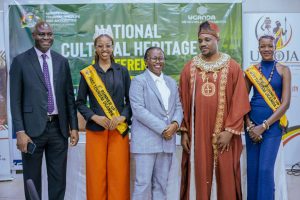
BY D KASULE: Preservationists, government officials, and cultural experts have called for stricter urban planning measures to safeguard Uganda’s architectural and infrastructural heritage, warning that unchecked urban growth is steadily erasing the country’s historical identity.
The call was made during the Third National Cultural Heritage Conference, where stakeholders expressed concern that rapid and often unplanned urbanization is threatening historic buildings, traditional spaces, and cultural landscapes across the country.
State Minister for Tourism, Wildlife and Antiquities, Martin Mugarra, said Uganda’s expanding cities driven by infrastructure development, population growth, and environmental pressures are outpacing efforts to protect heritage.
“Our cities are growing rapidly, but much of this growth is happening without proper planning,” Mugarra said. “As a result, we are steadily losing historic buildings, traditional layouts, and cultural landscapes that define who we are.”
Across urban centers such as Kampala, Gulu, Jinja, and Fort Portal, old structures are increasingly being demolished to make way for modern developments. Experts warn that without firm planning controls, this trend could erase important layers of Uganda’s history, from pre-colonial heritage to colonial and post-independence architecture.
Participants stressed that preservation must go hand in hand with development, rather than being treated as an obstacle. They argued that stronger zoning laws, enforcement mechanisms, and planning frameworks are urgently needed to protect heritage sites and buildings.
Mugarra emphasized that architectural heritage extends beyond physical structures to include cultural practices, social spaces, and shared memory. “When we lose these spaces, we lose our identity. Our cities risk becoming places without memory or meaning,” he said, urging planners to adopt development models that integrate heritage into modern urban design.
Dr. Basil Ajar, Director of Tourism at the Ministry of Tourism, Wildlife and Antiquities, speaking on behalf of the Permanent Secretary, said Uganda is at a defining moment where decisions made today will shape the character of its cities for generations. “Do we want cities that only reflect modern infrastructure, or cities that also carry memory, character, and cultural identity?” he asked.
He noted that heritage should be viewed as a foundation for sustainable development, supporting tourism, education, and community cohesion. However, he acknowledged that weak enforcement of existing regulations and limited public awareness continue to undermine conservation efforts.
Stakeholders also highlighted the growing loss of indigenous architectural knowledge. Traditional building methods—once aligned with local environments and cultural values are increasingly being replaced by modern designs that often ignore context and identity.
Dr. Anthony Kakooza warned that Uganda’s cultural heritage, including traditional knowledge systems, is at risk of disappearing if deliberate action is not taken. “If people do not understand the value of their heritage, they will not protect it,” Kakooza said, noting that younger generations are becoming less connected to cultural traditions.
The conference underscored the need to preserve both tangible and intangible heritage. While buildings and monuments are visible symbols, the rituals, skills, and traditions associated with them are equally important. Citing the restoration of the Kasubi Tombs after the site was destroyed by fire in 2010, participants noted that rebuilding required not only physical reconstruction but also the revival of traditional craftsmanship and cultural practices highlighting the complexity of heritage preservation.
Stakeholders also raised concerns over increasing construction near heritage sites, often without clear zoning regulations or protective buffer zones, which threatens their integrity and cultural significance.
To address these challenges, preservationists called for a more stringent urban planning approach. Recommendations included enforcing heritage protection laws, strengthening institutional capacity, investing in documentation and research, and introducing incentives for property owners to conserve historic buildings.
Mugarra reaffirmed the government’s commitment to improving legal and policy frameworks but stressed that preservation requires collective responsibility.
“Protecting our heritage is a shared duty. It involves planners, architects, investors, communities, and cultural institutions,” he said.
Stakeholders asserted that Uganda must rethink its urban development strategy to ensure that growth does not come at the cost of its identity. “The future of our cities depends not only on what we build, but on what we preserve,” Mugarra said. “We must pursue development that is modern, but also rooted in our culture and conscious of our past.”