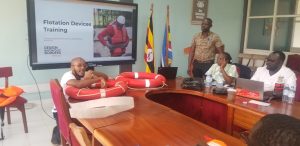
BY JOSEPH KATO: In a bid to combat the rampant deaths caused by drowning, water mobility experts have called for increased awareness, sensitization, and training programs focusing on survival skills for lakes and rivers.
Dens Nkurunziza, water safety expert at Design Without Borders, said many people drown in lakes and rivers because they lack the skills to float for prolonged periods while waiting for rescue.
Nkurunziza, who was sensitizing journalists in Kampala about drowning cases in the country, noted that many people train in swimming pools and assume they have acquired sufficient skills. However, he explained that pool training does not adequately prepare swimmers for large water bodies such as lakes and rivers.
“When you are in danger, you need skills to survive. You need to float to live. Your swimming pool skills may not help you survive. It is very easy to get injured. It becomes even more difficult when you are not wearing a life jacket,” Nkurunziza said.
The training attracted journalists from both legacy and online media houses, including Daily Press Uganda, New Vision, Bukedde, Nile Post, NBS Television, Uganda Radio Network, and Alternative Media. The event was held at the National ICT Hub in Nakawa Division, Kampala.
According to Otto Businge, a public health researcher at Makerere University School of Public Health, Uganda needs to do more to reduce the more than 3,000 deaths recorded annually from drowning in pools, lakes, rivers, ponds, and septic tanks.
Businge explained that many children drown in locations within 500 metres of their homes, including private swimming pools, open ponds, and shadoofs. To protect children, he urged parents and guardians to ensure that caregivers are equipped with necessary swimming skills and that hazardous areas such as swimming pools are securely closed.
“When you look at the data of 3,000 deaths resulting from drowning, it means Uganda is losing eight to nine people daily. These deaths are preventable. They can be reduced by ensuring that people who frequently use water as a means of transport are provided with safety gear,” Businge said.
Charles Okao, GHAI’s media coordinator, said journalists often report drowning incidents as isolated events, leading authorities to perceive them as one-time occurrences. “The purpose of this training is to ensure that you journalists start seeing drowning as a public health problem rather than isolated incidents. You need to treat drowning as an issue that concerns everyone and requires urgent attention. You can do this by going beyond reporting events and highlighting the broader impact and implications of each case,” Okao said.
Nkurunziza further explained that many fishermen drown because they believe they are accustomed to life on the lake and therefore see no need to use safety gear. He added that some fishermen hold misconceptions about wearing life jackets. “Some fishermen believe life jackets attract hippos. Others claim they are uncomfortable because they are heavy and cause excessive sweating, especially while fishing. This shows there is insufficient sensitization on the importance of life jackets,” Nkurunziza said.
He also noted that the high cost of life jackets remains a major barrier. A single life jacket that meets international standards costs about 210,000 shillings, making it unaffordable for many fishing communities. “In some fishing communities, there is a belief that protection devices such as life jackets attract hippos. There are also concerns about comfort. We need to design life jackets that are more comfortable for fishermen, especially while they are carrying out their daily activities,” Nkurunziza added.