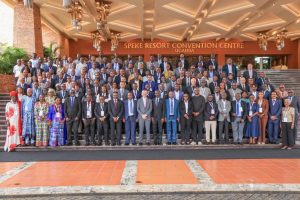
BY D KASULE: Africa’s maritime leaders, want the continent to implement its idle naval policies to steer economy development. This joint call to action, was during the 9th Annual General Assembly and Conference of the Association of African Maritime Administrations (AAMA) in Kampala.
The summit observed that the continent has no shortage of policies, both regional and international, however the test now is whether they change anything on the water, in the ports and in people’s lives.
The meeting, is being held under the theme “From Policy to Practice: Advancing Africa’s Maritime Transformation through Effective Governance, Innovation and Sustainable Blue Economy.”
Participants, the gap between what governments commit to and what they deliver. While presiding over the opening ceremony, Minister of Works and Transport, Fred Byamukama, said Africa has shown considerable strength in drafting policies, strategies and regulatory frameworks but still struggles to turn them into results. He pointed to the institutional capacity needed to enforce and sustain commitments as the missing piece.
He says “Uganda’s ratification of the Revised African Maritime Transport Charter, was need to bring it into force, that even a land-linked country without a direct ocean coastline can play a decisive role in anchoring Africa’s maritime legal and institutional framework.”
He also pressed the right of landlocked states to access the sea and freedom of transit under the UN Convention on the Law of the Sea. Those rights, he said, are “essential instruments for economic transformation, national development and our effective participation in the African Continental Free Trade Area.”
Byamukama said Africa has been strong at drafting policy but weak at delivery. “The persistent gap between policy formulation and effective implementation, particularly the institutional capacity required to enforce and sustain our commitments, must be addressed,” he said.
International Maritime Organization (IMO) Secretary-General Arsenio Dominguez said the theme sets “a clear expectation.” He added: “Our priority is not simply to develop policies, but to translate them into concrete results.” He stressed that “effective governance is the foundation for this delivery,” and said ratification must be followed by national legislation, capable institutions and consistent enforcement.
“Domestic Ferry Safety deserves particular urgency,” he said, calling for effective inspections, safe loading, competent crews, emergency preparedness and impartial casualty investigation. “A ferry safety workshop with MOESNA and the IMO was held in Kampala the day before the conference,” he revealed.
“Transformation ultimately depends on people,” Dominguez said, investment in maritime education, training and certification, and equitable access for women to training, sea time and leadership, is also necessary. Ministry of works Permanent Secretary Waiswa Bageya put it in terms of measurement. Progress, he said, should not be judged by the number of policies written, conventions ratified or declarations adopted, but by improvements in sector performance, economic competitiveness and livelihoods.
Bageya said Africa “has never lacked ambition,” but that progress should be measured by what changes for people. “We must leave this Assembly with more than resolutions and declarations,” he said. He added that Africa should aim to supply skilled seafarers to the world fleet. “Our ambition should be to ensure that Africa is not merely a consumer of global maritime services, but also a significant contributor of the skilled professionals who drive the industry,” he said.