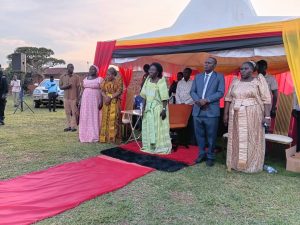
DANIEL MUMBYA: The First Deputy Prime Minister and Minister for East African Community Affairs, Rt. Hon. Rebecca Alitwala Kadaga, has urged the people of Busoga to make good use of the facilities and opportunities they already have instead of waiting for bigger and more modern structures.
Kadaga, who is also the Woman Member of Parliament for Kamuli District, said Basoga should support and develop the available facilities, including Busoga University, before demanding for bigger buildings and other expensive infrastructure.
She said some Busoga leaders are undermining the existing university facilities by focusing too much on the buildings instead of the education and opportunities the institution can provide.
“Knowledge does not depend on having better buildings. What matters most is determination. Before the government took over the university, there were no big or modern buildings, but people still studied there and many have succeeded,” Kadaga said.
She made the remarks at Top Care Secondary School in Iganga Municipality, where she was the chief guest at a fundraising event to support the construction of a main hall at the school. Kadaga also announced that the government is planning to establish a second skilling hub in Bugiri District to increase access to vocational training in the Busoga sub-region.
She said the existing Nakabango Skilling Hub can only accommodate six students from each district and municipality, making it necessary to establish another centre to serve more young people. Kadaga urged residents to take advantage of government programmes such as Emyooga, the Parish Development Model and the Youth Livelihood Programme to improve their household incomes and fight poverty.
“Let us embrace all government programmes such as Emyooga, the Parish Development Model, the Youth Livelihood Programme and others. These programmes are meant to help our people fight poverty,” she said.
Jinja-Kampala Expressway
On transport, Kadaga said the government is pushing ahead with plans to construct the long-awaited Jinja-Kampala Expressway. She said the expressway will help reduce traffic congestion along the busy Kampala-Jinja route while also improving trade, industrialisation and regional integration within the East African Community.
Kadaga noted that the current Jinja-Kampala road has become a major challenge for businesses because of heavy traffic and delays. She said the expressway would make it easier to transport goods and people and could also make Busoga more attractive to investors.
The fundraising event brought together parents, former students, education leaders, political leaders and other well-wishers from across Busoga. Top Care Secondary School is steadily growing into one of the promising private secondary schools in Iganga.
Kadaga contributed Shs5 million towards the school’s development projects. She commended the school directors and teachers for their commitment and sacrifice in educating and raising disciplined children who can contribute to the future development of Busoga and Uganda.
The Member of Parliament for Busiki County in Namutumba District, Joel Azalwa, also urged parents to educate their children to the highest level possible while encouraging them to acquire vocational skills. He said young people should, where possible, be trained in a practical skill alongside their formal education so that they can become self-reliant after completing school.
Azalwa said skills such as cake baking, bricklaying, driving and motor vehicle mechanics could help reduce the number of young people travelling abroad in search of jobs. He encouraged young people to use the skills they acquire to create their own jobs and employ others.
School Challenges
Meanwhile, the head teacher of Top Care Secondary School, Richard Kibwika, said the school is facing several challenges, including a lack of equipment for vocational training. He said the school conducts vocational training every weekend in line with the requirements of the new curriculum, but the lack of adequate equipment makes it difficult to provide effective practical training.
Kibwika also said the school had more than 1,000 students before the COVID-19 pandemic when it was partnering with the government under the Universal Secondary Education programme. However, he said the partnership was later cancelled, causing the school’s population to drop to about 200 students. He said the decline in student numbers has affected the school’s income and slowed down its development.