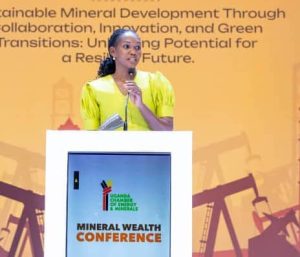
The Minister of Energy and Mineral Development, Ruth Nankabirwa, has urged investors in the mineral and mining to prioritize mineral value addition, as the surest path to jobs, industries, and sustainable development. She made the call while opening the 14th Annual Mineral Wealth Conference in Kampala, under the theme “Sustainable Mineral Development through Collaboration, Innovation, and Green Transition.”
Nankabirwa said Uganda is blessed with abundant resources and a young, dynamic population. She warned that if the youth are not properly guided, they may seek uncontrolled ways of accessing resources, creating risks for both government and communities.
“The enlightened population will find their own means of accessing the resources we talk about if not well guided,” she said. “We must remember that sustainable mineral development also means protecting fertile soils, water resources, and energy for future generations.”
She emphasized that Uganda should not continue exporting raw materials but must build industries that process minerals into finished products. “Mineral wealth is not about extraction alone,” she said. “It is about industrialization, technology transfer, and creating industries that can compete on the global market.”
Nankabirwa added that government has introduced new laws, streamlined licensing, and strengthened environmental safeguards to attract responsible investors while ensuring that minerals benefit ordinary Ugandans. Aggrey Ashaba, chairman of the Uganda Chamber of Energy and Minerals, praised recent progress in formalizing small-scale mining and establishing the Uganda National Mining Company.
He recalled his visit to Moroto more than a decade ago, where women and children mined stones by hand without protective gear. “Today we see progress,” he said. “Artisanal miners are being recognized, new laws are in place, and a state mining company exists. But we must go further.”
Ashaba pointed to Tanzania, where gold mining has created entire towns and thriving jewelry industries. He urged Uganda to learn from that example and embrace value addition so that minerals create towns, industries, and jobs at home. “Mining may be king, but value addition and national content are King Kong,” he said. “We must build industries here, not export opportunities abroad.”
The Chamber has set a target of raising mining’s contribution to GDP from about 1 percent to between 8 and 10 percent within five years. Ashaba said this is achievable with consistent policies, investment, and collaboration among government, private companies, and communities.
James Ssebugenyi, chairman of the newly formed Uganda National Mining Company, explained its mandate and vision. He said the company’s role is to stimulate investment in strategic minerals, take part in exploration and processing, and hold government’s equity in medium and large-scale projects. “Our vision is to become a sustainable, profitable, world-class mining company that creates value for all Ugandans,” he said.
The company has already signed a mineral production sharing agreement with Sarai Group and Nile Fibre Board for the redevelopment of Kilembe copper mines, where it holds a 15 percent stake. It is also preparing to participate in other projects as part of its broader strategy.
Ssebugenyi stressed that the company will operate responsibly, balancing business goals with the need to protect communities and the environment. Development partners welcomed Uganda’s efforts but urged the country to match mineral exploitation with careful planning and environmental responsibility. They called for stronger investment in skills training, geological surveys, and local participation.
International experts also shared lessons from other countries. They warned that nations which depend only on raw exports often face instability and miss out on jobs and industries. Uganda, they said, should use its mineral wealth to diversify the economy, build infrastructure, and support industries that will last long after mines are closed.
They emphasized that the global demand for minerals is rising because of the clean energy transition. Countries that invest in value addition, rather than just extraction, will benefit the most from this shift. The conference also highlighted environmental concerns. Participants noted that unchecked mining and deforestation could affect water systems and hydropower, which Uganda relies on heavily for electricity.
Nankabirwa echoed this concern, saying: “The future of mining must be sustainable. We cannot destroy our environment while trying to benefit from minerals.” Delegates recommended several actions to strengthen Uganda’s mining sector speeding up licensing and approvals for serious investors, giving incentives to companies that set up processing plants, training Ugandans in modern mining and processing skills, expanding geological surveys, and building stronger regional cooperation for trade in minerals.
Uganda is at a turning point. With the right mix of policies, partnerships, and responsible practices, the country can become a hub for mineral-based industries in East Africa. The Minister reminded participants of the difference between mineral wealth and mineral development. “Wealth comes from value addition,” she said.
“Development comes from building the infrastructure, roads, water, and power that makes value addition possible. This is our chance to turn minerals into jobs, industries, and lasting prosperity. We must do it together, for the benefit of all Ugandans,” Nankabirwa concluded.